
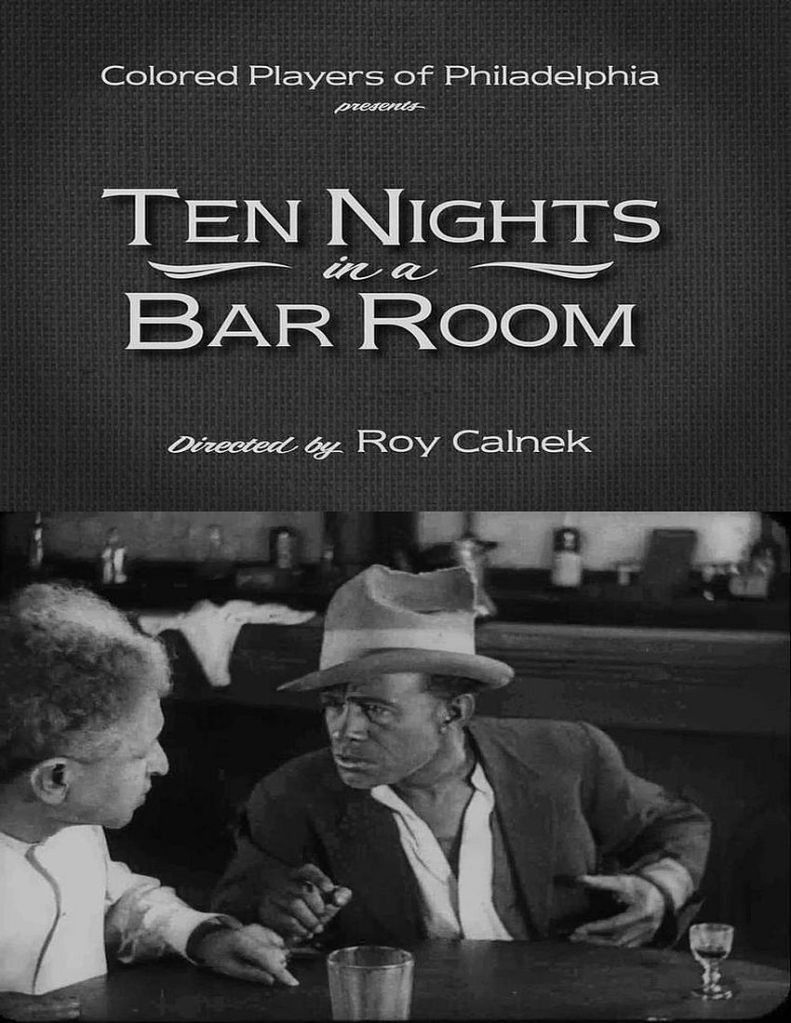
#811) Ten Nights in a Bar Room (1926)
OR “Temperance, Temperance”
Directed by Roy Calnek
Based on the novel “Ten Nights in a Bar-Room and What I Saw There” by Timothy Shay Arthur and the play adaptation by William W. Pratt.
Class of 2025
The Plot: Local tavern the Sickle and Sheaf in the town of Cedarville is the setting for this melodrama. It seems that the tavern (and the inn that houses the tavern) was recently taken over by Simon Slade (Lawrence Chenault) who swindled ownership away from his business partner Joe Morgan (Charles Gilpin). Despondent, Joe turns to drinking and quickly becomes the town drunk, spending his days at the Sickle and Sheaf rather than with his wife Fannie and their young daughter Mary (Myra Burwell and Actor Unknown). There’s plenty of unnecessary subplots and preaching on the dangers of alcohol to go around in one of the earliest surviving films with an all-Black cast.
Why It Matters: The NFR write-up gives the briefest of historical significance for this film, which we’ll get into as we go.
But Does It Really?: Obviously any silent era Black cinema should be preserved, but “Ten Nights” has one thing going for it that gives it a unique quality. This was the fourth film adaptation of the novel “Ten Nights in a Bar-Room” (a very popular novel at the time), but the first with an all-Black cast. Turns out this movie was the “The Wiz” of its day! While the film as a whole was a bit of a slog to get through, its historical significance (and its representation of the short-lived Colored Players Film Corporation) helps it stand out among its NFR contemporaries.
Everybody Gets One: Although this is Charles Sidney Gilpin’s sole NFR appearance (and one of his rare film roles), he has an important connection to another NFR movie. Primarily a stage actor, Gilpin originated the role of Brutus Jones in Eugene O’Neill’s “The Emperor Jones”. His refusal to use that word on stage led to him being bypassed for the eventual film adaptation with Paul Robeson.
Wow, That’s Dated: This is another one of those movies of the era where drinking and gambling are the two greatest evils in the world, and the results are always fatal.
Title Track: The punctuation surrounding the words “Bar Room” has led to some confusion over the years. The original books spells it “Bar-Room”, while other adaptations opt for “Bar-room”. Several listings for this film (including the official NFR write-up) list the word as “Barroom”, but as always, when in doubt I go with the film’s title card, which in this case separates it into two distinct words. Granted, the title card appears to be a recreation for the 2016 restoration, so we may never know for sure.
Other notes
- The Colored Players of Philadelphia, aka The Colored Players Film Corporation, was founded in 1926 by actor Sherman H. Dudley and theater owner David Starkman. Both men were interested in producing Black films free from the stereotypes prevalent in minstrel shows and other movies of the time. “Ten Nights” was the second film produced by the company, following “A Prince of His Race” earlier that same year.
- This is the second movie from the Class of 2025 with an unnecessary framing device, in this case a traveling salesman who visits Cedarville once a year and saw everything that happened to Joe and Simon. It’s a holdover from the novel, but man does it slow down the movie.
- Speaking of extraneous characters, this movie sure has a lot of them. The first ten minutes of the movie is mostly title cards introducing all of these characters. This movie’s only an hour long, do we need all these subplots?
- One of the side characters is named Mehitable, a name I’ve never heard before and probably never will again. It’s an Old Testament name based on the Hebrew word for “God benefits”. Speaking of, Mehitable’s actor Arline Mickey (and her scene partner Edward Moore as Sample Swichel) are playing to the back of the house. Tone it down you two, it’s a movie.
- We get some fun special effects when the bottle Joe is holding in his hand turns into a snake. And that is definitely a real snake. Ah, the dangers of silent film.
- No spoilers, but like so many films of this era, things take a tragic turn. It all comes across as a bit heavy-handed through a modern lens, but I’ve come to expect these melodramas to be…melodramatic.
- Sometimes I wonder: Did any of this movie’s cast or crew have any idea what the future would hold for this movie? Did any of them suspect it would be viewed 100 years later as a historical artifact, to say nothing of the technology enabling this film to be viewed anywhere in the world? Just a thought.
- [Spoilers] This movie’s finale involves an angry mob, plus some nice model work as the tavern is set on fire. I’m just curious how the stage adaptation handled all of this. We end with a title card labeled “Retribution”, with a sort-of happy ending for Joe that as best I can tell isn’t in the original book.
Legacy
- Colored Players Film Corporation made two more films after “Ten Nights”: “Children of Fate” and “The Scar of Shame” (its only sound feature). The company shut down around 1929 following money mismanagement, as well as strong competition from other Black filmmakers like Oscar Micheaux. Of the four films produced, only “Ten Nights” and “The Scar of Shame” are known to survive.
- “Ten Nights” received one more remake in 1931, a sound version starring William Farnum. After that, the novel and its subsequent film adaptations all faded into obscurity. The 1926 “Ten Nights” got a reprieve in 2016 when it was released by Kino Lorber as part of their “Pioneers of African-American Cinema” collection, including “Within Our Gates”, “The Blood of Jesus”, and several other noteworthy NFR titles.

 The Horse's Head